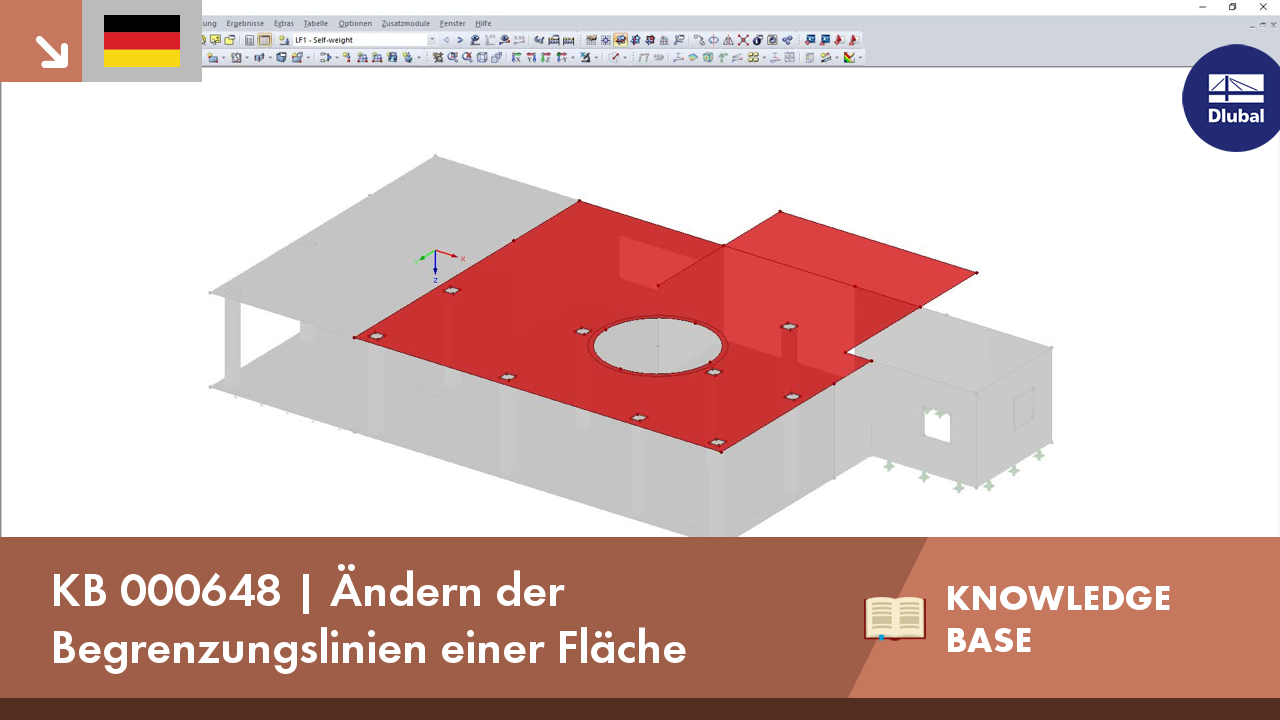
Dlubal: Precision and Efficiency in Editing Surface Boundary Lines – A Game Changer for Engineers
In the demanding world of structural engineering, design iterations are not just common; they are an integral part of the process. From initial concept to final construction, geometries evolve, parameters shift, and optimizations become necessary. This constant flux often presents a significant challenge: how to efficiently modify complex structural elements without having to completely redefine them from scratch. This is precisely where Dlubal software shines, offering intuitive tools that empower engineers to edit surface boundary lines with unprecedented ease, saving valuable time and ensuring design accuracy.
Whether you're meticulously verifying the exact "Länge Einer Begrenzungslinie Geometrie 11 Buchstaben" (a specific query for the length of a boundary line geometry, 11 letters, in German) for a highly sensitive component, or simply adjusting a perimeter in a complex slab, the underlying need is always the same: precise control and efficient editing. Dlubal addresses this need head-on, transforming what was once a laborious task into a streamlined process.
The Evolving Landscape of Structural Geometry: A Design Challenge
Modern structural designs are rarely static. They are dynamic entities, constantly refined by a multitude of factors. Client feedback might necessitate a change in architectural aesthetics, leading to altered surface profiles. Optimization processes, perhaps driven by material cost or structural performance, could require adjustments to slab edges or wall boundaries. Even unforeseen site conditions can demand last-minute modifications to the geometric definition of structural elements.
Traditionally, such changes could trigger a cascade of time-consuming and frustrating rework. Imagine a complex surface with dozens of intricate boundary lines. If a few of these lines needed to be removed or altered, conventional methods might force engineers to:
- Redefine the entire surface: This means deleting the existing surface and painstakingly recreating it, including all its associated properties and loads.
- Manual reconstruction: Individually selecting and deleting points and lines, then drawing new ones, often leading to precision errors and inconsistencies.
- Loss of associated data: Redefining a surface can sometimes mean re-assigning materials, thicknesses, and loads, duplicating efforts and increasing the risk of omissions.
These challenges not only consume precious engineering hours but also introduce potential for errors, impacting project timelines and budgets. Recognizing this critical pain point, Dlubal developed a sophisticated yet user-friendly solution to manage these geometric changes seamlessly.
Dlubal's Seamless Approach to Modifying Surface Boundary Lines
Dlubal software fundamentally changes how engineers interact with and modify structural geometries. Instead of the laborious process of redefining entire surfaces, Dlubal offers a targeted, intuitive workflow that focuses solely on the necessary changes to boundary lines. This approach is particularly beneficial for geometrically intricate surfaces featuring numerous boundary definitions.
The process is remarkably straightforward, embodying Dlubal's commitment to user-centric design:
- Access the Edit Dialog: To initiate modifications, simply double-click on the surface in question within your Dlubal model. This action instantly opens the "Edit Surface" dialog box, presenting all relevant parameters and options for that specific surface.
- Utilize the Pick Function: Within the "Edit Surface" dialog, you'll find a powerful "Pick" function. This tool allows you to directly interact with the boundary lines of your chosen surface.
- Select and Deselect Boundary Lines:
- Adding Lines: By clicking on unselected boundary lines in your model while the Pick function is active, these lines are added to the surface's boundary definition and appear in the list within the dialog box.
- Removing Lines: The true genius lies here. If a line is already part of the surface's boundary definition (i.e., it's present in the list) and you click on it again using the Pick function, Dlubal intelligently removes it from the list. This means you don't have to navigate through complex menus or manually delete elements; a simple re-selection performs the removal.
This streamlined method means that if a client requests a minor tweak to a slab edge, or an optimization study suggests altering the perimeter of a wall, you can make those changes with a few clicks, without disrupting the entire model. The surface itself remains defined with its properties, loads, and meshing. This significantly reduces the time spent on rework and allows engineers to focus on more critical aspects of the structural analysis and design. For a more in-depth guide on this process, you can refer to How to Modify Surface Boundaries in Dlubal Software Quickly.
Precision and Efficiency: Advanced Strategies for Managing Complex Geometries
While Dlubal's core functionality for editing boundary lines is inherently efficient, mastering the software means understanding how to integrate these tools into a broader, optimized workflow. Beyond the basic double-click and pick function, engineers can employ several strategies to maximize precision and accelerate their work on complex geometries.
- Leverage Layer Management: For highly intricate models, thoughtful layer management is crucial. Assigning different types of elements (e.g., structural members, non-structural elements, boundary lines, reference lines) to distinct layers allows you to isolate and modify specific parts of your geometry without affecting others. This dramatically improves clarity and reduces the chance of accidental selections.
- Utilize Snapping and Ortho Modes: Accuracy is paramount. Always make full use of Dlubal's snapping functionalities (to points, lines, midpoints, intersections) and ortho modes. These ensure that any modified or newly defined boundary lines align perfectly with existing geometry, maintaining the structural integrity and precision required for analysis.
- Employ Reference Objects: Sometimes, creating temporary construction lines, points, or even dummy surfaces can serve as invaluable references for precisely repositioning or redefining boundary lines. Once the main modifications are complete, these reference objects can be easily deleted.
- Understand Parametric Relationships: In some Dlubal modules, geometric entities can have parametric relationships. Be aware of how modifying one boundary line might influence others that are parametrically linked. This foresight allows for more informed and efficient changes.
- Regularly Review and Verify: After making significant geometric changes, always take a moment to visually review your model from various angles. Utilize Dlubal's built-in validation and error checking tools to catch any unintended gaps, overlaps, or discrepancies that might arise, ensuring the integrity of your finite element model before analysis.
- Keyboard Shortcuts and Customization: Become familiar with Dlubal's keyboard shortcuts. Customizing your interface and quick access toolbars can further streamline repetitive tasks, making the boundary line editing process even faster.
The ability to efficiently manage complex geometries is not just about speed; it's about maintaining a high level of precision throughout the design process. Whether you're rigorously defining a component and pondering the exact "Länge Einer Begrenzungslinie Geometrie 11 Buchstaben" (which translates to 'length of a boundary line geometry, 11 letters' in German, a phrase indicating a precise geometric query) or simply need to tweak a minor edge, Dlubal's robust tools provide the granular control necessary to ensure every dimension and every boundary is exactly as intended. To further explore strategies for handling intricate designs, you can read Manage Complex Geometries: Dlubal's Boundary Line Editing.
Tangible Impact: Streamlining Projects and Enhancing Structural Integrity
The benefits of Dlubal's efficient boundary line editing extend far beyond mere convenience. They translate into significant, tangible advantages across the entire structural engineering project lifecycle:
- Accelerated Design Iteration Cycles: With the ability to quickly adapt geometries, engineers can explore more design alternatives, respond faster to client changes, and optimize structures with greater agility, leading to superior final designs.
- Minimized Risk of Errors: The targeted nature of Dlubal's editing process drastically reduces the chances of introducing errors. By only modifying specific boundary lines rather than redefining entire surfaces, the integrity of existing properties and analyses is preserved.
- Improved Project Collaboration: When design changes can be implemented swiftly and accurately, it fosters better collaboration among project stakeholders. Architects, engineers, and fabricators can work in a more integrated manner, reacting to updates without significant delays.
- Enhanced Design Flexibility: Dlubal empowers engineers with the flexibility to fine-tune designs even at advanced stages. This adaptability is invaluable when dealing with unforeseen circumstances or when striving for innovative, complex structural forms.
- Significant Cost Savings: Ultimately, time saved in the design phase translates directly into cost savings. Less rework, fewer errors, and faster project completion contribute to more profitable outcomes for engineering firms.
Conclusion
Dlubal software's intelligent approach to editing surface boundary lines stands as a testament to its commitment to empowering structural engineers. By providing a streamlined, intuitive workflow, it eliminates the inefficiencies of traditional geometric modifications, allowing for rapid adaptation of designs without compromising accuracy. This capability is not just a feature; it's a fundamental shift that enables engineers to manage dynamic structural projects with greater confidence, precision, and speed. In an industry where time is money and accuracy is paramount, Dlubal's tools are indispensable for navigating the complexities of modern structural design, ensuring that every project, regardless of its geometric intricacies or the specific dimensions required, progresses efficiently towards a successful realization.